转载说明:本文原作者为 Ray Dalio(Bridgewater Associates 桥水基金创始人,《纽约时报》畅销书《原则》作者)。原文发布于 2026 年 2 月 15 日的 X (Twitter)。原文链接:It’s Official: The World Order Has Broken Down。以下为中英双语对照版本,英文为原文,中文为翻译。
作者简介:Ray Dalio,桥水基金(Bridgewater Associates)创始人,《纽约时报》第一畅销书《原则》(Principles)作者,自称"专业犯错者"(professional mistake maker)。
It’s Official: The World Order Has Broken Down
官宣:世界秩序已经瓦解
At the Munich Security Conference, the post-1945 world order was pronounced dead by most leaders and the picture behind it was laid out in the Security Report 2026, entitled “Under Destruction,” which you can read here if you’re interested. More specifically, German Chancellor Friedrich Merz said, “The world order as it has stood for decades no longer exists,” and that we are in a period “great power politics.” He made clear that freedom “is no longer a given” in this new era. French President Emmanuel Macron echoed Merz’s assessment and said that Europe’s old security structures tied to the previous world order don’t exist and that Europe must prepare for war. U.S. Secretary of State Marco Rubio said that we are in a “new geopolitics era” because the “old world” is gone.
在慕尼黑安全会议上,大多数领导人宣告了1945年以来的世界秩序已经终结,其背后的全景在2026年安全报告中被详细描述,该报告题为《正在瓦解》(Under Destruction),如果你感兴趣可以在此阅读。更具体地说,德国总理弗里德里希·默茨(Friedrich Merz)表示:"延续了数十年的世界秩序已不复存在",我们正处于一个"大国政治“的时期。他明确指出,在这个新时代,自由"不再是理所当然的”。法国总统埃马纽埃尔·马克龙(Emmanuel Macron)呼应了默茨的判断,表示欧洲与旧世界秩序绑定的安全架构已不复存在,欧洲必须为战争做好准备。美国国务卿马尔科·卢比奥(Marco Rubio)表示,我们正处于一个"新地缘政治时代",因为"旧世界“已经消逝。
In my parlance, we are in the Stage 6 part of the Big Cycle in which there is great disorder arising from being in a period in which there are no rules, might is right, and there is a clash of great powers. How Stage 6 works is explained in detail in Chapter 6, “The Big Cycle of External Order and Disorder,” in my book Principles for Dealing with the Changing World Order. While I previously shared a lengthy set of excerpts from Chapter 5 (“The Big Cycle of Internal Order and Disorder”), so you could see how what is going on with the United States tracks the classic cycle explained in that chapter, I am including all of Chapter 6 here for your review. Given the now nearly universal agreement that the post-1945 world order has broken down and that we are entering a new world order, I think it would be worth your time to read.
用我的术语来说,我们正处于大周期(Big Cycle)的第六阶段,这一阶段的特征是巨大的混乱——源于一个没有规则、强权即公理、大国相互碰撞的时期。第六阶段的运作机制在我的著作《应对变化中的世界秩序的原则》(Principles for Dealing with the Changing World Order)第六章"外部秩序与混乱的大周期"中有详细阐述。此前我已分享了第五章(“内部秩序与混乱的大周期”)的大量摘录,以便你们看到美国正在发生的事情如何与该章阐述的经典周期相吻合。现在我将第六章全文附在此处供你们参阅。鉴于目前几乎所有人都认同1945年以来的世界秩序已经瓦解、我们正在进入一个新的世界秩序,我认为值得花时间一读。
Chapter 6: The Big Cycle of External Order and Disorder
第六章:外部秩序与混乱的大周期
Relationships between people and the orders that govern them work in basically the same ways, whether they are internal or external, and they blend together. In fact, it wasn’t long ago that there were no distinctions between internal and external orders because there were no clearly defined and mutually recognized boundaries between countries. For that reason, the six-stage cycle of going between order and disorder that I described in the last chapter about what happens within countries works the same way between countries, with one big exception: international relations are driven much more by raw power dynamics. That is because all governance systems require effective and agreed-upon 1) laws and law-making abilities, 2) law enforcement capabilities (e.g., police), 3) ways of adjudicating (e.g., judges), and 4) clear and specified consequences that both suit crimes and are enforced (e.g., fines and incarcerations), and those things either don’t exist or are not as effective in guiding relations between countries as they are in guiding relations within them.
人与人之间的关系以及治理这些关系的秩序,无论是在国内还是在国际层面,其运作方式基本相同,而且它们相互交融。事实上,不久之前,内部秩序与外部秩序之间并没有区别,因为国家之间并不存在清晰界定且相互承认的边界。因此,我在上一章中描述的国家内部在秩序与混乱之间交替的六阶段周期,在国家之间同样适用,但有一个重大区别:国际关系更多地由原始的权力动态所驱动。这是因为所有治理体系都需要有效且被认可的:1)法律和立法能力,2)执法能力(如警察),3)裁决途径(如法官),以及4)明确规定且能够实施的、与罪行相匹配的后果(如罚款和监禁),而这些要素在国家间关系中要么不存在,要么远不如在国家内部关系中那样有效。
While attempts have been made to make the external order more rule-abiding (e.g., via the League of Nations and the United Nations), by and large they have failed because these organizations have not had more wealth and power than the most powerful countries. When individual countries have more power than the collectives of countries, the more powerful individual countries rule. For example, if the US, China, or other countries have more power than the United Nations, then the US, China, or other countries will determine how things go rather than the United Nations. That is because power prevails, and wealth and power among equals is rarely given up without a fight.
虽然人们曾尝试让外部秩序更加遵循规则(例如通过国际联盟和联合国),但总体而言这些尝试都失败了,因为这些组织并不比最强大的国家拥有更多的财富和权力。当单个国家的力量超过国家集体时,更强大的单个国家就会主导一切。例如,如果美国、中国或其他国家比联合国更强大,那么决定事态走向的就是美国、中国或其他国家,而非联合国。这是因为权力至上,而在势均力敌者之间,财富和权力很少会不经一战就拱手让出。
When powerful countries have disputes, they don’t get their lawyers to plead their cases to judges. Instead, they threaten each other and either reach agreements or fight. The international order follows the law of the jungle much more than it follows international law.
当强国之间产生争端时,它们不会让律师去法官面前为自己辩护。相反,它们互相威胁,然后要么达成协议,要么兵戎相见。国际秩序遵循的是丛林法则,远多于遵循国际法。
There are five major kinds of fights between countries: trade/economic wars, technology wars, capital wars, geopolitical wars, and military wars. Let’s begin by briefly defining them.
国家之间的争斗主要有五种类型:贸易/经济战、技术战、资本战、地缘政治战和军事战。让我们先简要定义它们。
Trade/economic wars: Conflicts over tariffs, import/export restrictions, and other ways of damaging a rival economically
贸易/经济战:围绕关税、进出口限制以及其他经济损害对手手段的冲突
Technology wars: Conflicts over which technologies are shared and which are held as protected aspects of national security
技术战:围绕哪些技术可以共享、哪些技术作为国家安全的受保护内容而加以管控的冲突
Geopolitical wars: Conflicts over territory and alliances that are resolved through negotiations and explicit or implicit commitments, not fighting
地缘政治战:围绕领土和联盟的冲突,通过谈判以及明确或隐含的承诺来解决,而非武力对抗
Capital wars: Conflicts imposed through financial tools such as sanctions (e.g., cutting off money and credit by punishing institutions and governments that offer it) and limiting foreign access to capital markets
资本战:通过金融工具施加的冲突,例如制裁(如通过惩罚提供资金和信贷的机构及政府来切断资金和信贷渠道)以及限制外国进入资本市场
Military wars: Conflicts that involve actual shooting and the deployment of military forces
军事战:涉及实际开火和部署军事力量的冲突
Most fights between nations fall under one or more of those categories (cyber warfare, for example, has a role in all of them). They are over wealth and power and the ideologies pertaining to them.
国家之间的大多数争斗都属于上述一种或多种类型(例如,网络战在所有类型中都扮演着角色)。这些争斗的核心都是围绕财富、权力以及与之相关的意识形态。
While most of these types of wars don’t involve shooting and killing, they all are power struggles. In most cases, the first four kinds of war will evolve over time as intense competitions between rival nations until a military war begins. These struggles and wars, whether or not they involve shooting and killing, are exertions of power of one side over the other. They can be all-out or contained, depending on how important the issue is and what the relative powers of the opponents are. But once a military war begins, all four of the other dimensions will be weaponized to the greatest extent possible.
虽然大多数类型的战争不涉及枪炮和杀戮,但它们本质上都是权力斗争。在大多数情况下,前四种战争会随着时间推移,以对立国家之间激烈竞争的形式不断演化,直到军事战争爆发。这些斗争和战争,无论是否涉及枪炮和杀戮,都是一方对另一方施加权力的过程。它们可以是全面的,也可以是有限的,这取决于争议问题的重要程度以及对手之间的相对实力。但一旦军事战争爆发,其他四个维度都会被最大限度地武器化。
As discussed in the last several chapters, all of the factors that drive internal and external cycles tend to improve and worsen together. When things get bad, there are more things to argue over, which leads to greater inclinations to fight. That’s human nature, and it is why we have the Big Cycle, which oscillates between good times and bad ones.
正如前几章所讨论的,驱动内部和外部周期的所有因素往往同步改善或同步恶化。当形势恶化时,可争论的事情就会增多,这导致人们更倾向于战斗。这是人类的本性,也是我们存在大周期(Big Cycle)的原因——它在好时代与坏时代之间反复摆荡。
All-out wars typically occur when existential issues (ones that are so essential to the country’s existence that people are willing to fight and die for them) are at stake and they cannot be resolved by peaceful means. The wars that result from them make it clear which side gets its way and has supremacy in subsequent matters. That clarity over who sets the rules then becomes the basis of a new international order.
全面战争通常发生在事关存亡的问题(即对国家生存至关重要、人们愿意为之战斗和牺牲的问题)悬而未决,且无法通过和平手段解决之时。由此引发的战争会清楚地表明哪一方能够如愿以偿,并在此后的事务中占据主导地位。这种关于"谁来制定规则"的明确性,随后成为新国际秩序的基础。
The following chart shows the cycles of internal and external peace and conflict in Europe going back to 1500 as reflected in the deaths they caused. As you can see, there were three big cycles of rising and declining conflict, averaging about 150 years each. Though big civil and external wars last only a short time, they are typically the culmination of the longstanding conflicts that led up to them.
下图展示了自1500年以来欧洲内部与外部和平与冲突的周期,以其造成的死亡人数来衡量。如你所见,共有三个冲突上升与下降的大周期,每个周期平均约150年。尽管大规模的内战和对外战争只持续很短的时间,但它们通常是长期酝酿的冲突最终达到顶点的结果。
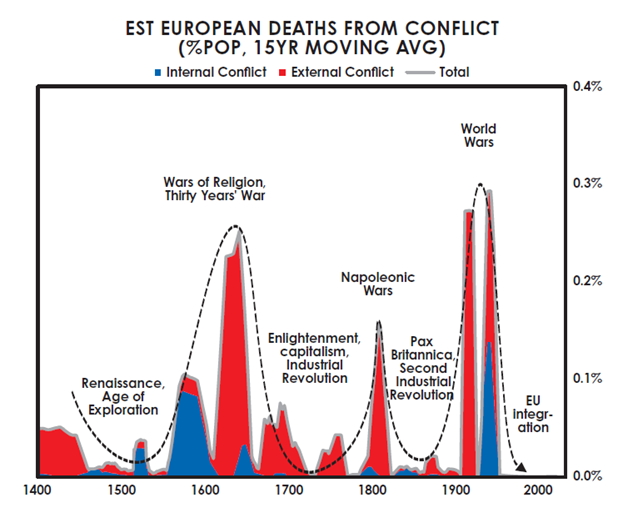
While World Wars I and II were separately driven by the classic cycle, they were also interrelated.
虽然第一次和第二次世界大战各自由经典周期驱动,但它们之间也相互关联。
As you can see, each cycle consisted of a relatively long period of peace and prosperity (e.g., the Renaissance, the Enlightenment, and the Industrial Revolution) that sowed the seeds for terrible and violent external wars (e.g., the Thirty Years’ War, the Napoleonic Wars, and the two World Wars). Both the upswings (the periods of peace and prosperity) and the downswings (the periods of depression and war) affected the whole world. Not all countries prosper when the leading powers do because countries gain at the expense of others. For example, the decline of China from around 1840 to 1949, known as the “Century of Humiliation,” came about because the Western powers and Japan exploited China.
如你所见,每个周期都由一段相对漫长的和平与繁荣时期(例如文艺复兴、启蒙运动和工业革命)构成,而这些和平繁荣恰恰为可怕的暴力对外战争(例如三十年战争、拿破仑战争和两次世界大战)埋下了种子。无论是上升期(和平与繁荣时期)还是下降期(萧条与战争时期),都影响了整个世界。并非所有国家都能在主导大国繁荣时同样繁荣,因为各国的获益往往以他国的损失为代价。例如,中国从大约1840年到1949年的衰落,即所谓的”百年屈辱"(Century of Humiliation),正是因为西方列强和日本对中国的剥削所致。
As you read on, keep in mind that * the two things about war that one can be most confident in are 1) that it won’t go as planned and 2) that it will be far worse than imagined. It is for those reasons that so many of the principles that follow are about ways to avoid shooting wars. Still, whether they are fought for good reasons or bad, shooting wars happen. To be clear, while I believe most are tragic and fought for nonsensical reasons, some are worth fighting because the consequences of not fighting them (e.g., the loss of freedom) would be intolerable.
在继续阅读时,请记住:* **关于战争,人们最有把握的两件事是:1)战争不会按计划进行;2)战争将远比想象中糟糕。**正是出于这些原因,接下来的许多原则都是关于如何避免武装战争的。然而,无论出于好的理由还是坏的理由,武装战争终究会发生。需要明确的是,虽然我认为大多数战争都是悲剧性的、因荒谬的理由而发动的,但有些战争值得一打,因为不打的后果(例如失去自由)将是不可忍受的。
THE TIMELESS AND UNIVERSAL FORCES THAT PRODUCE CHANGES TO THE EXTERNAL ORDER
推动外部秩序变革的永恒而普遍的力量
As I explained in Chapter 2, after self-interest and self-survival, the quest for wealth and power is what most motivates individuals, families, companies, states, and countries. Because wealth equals power in terms of the ability to build military strength, control trade, and influence other nations, domestic and military strength go hand in hand. It takes money to buy guns (military power) and it takes money to buy butter (domestic social spending needs). When a country fails to provide adequate amounts of either, it becomes vulnerable to domestic and foreign opposition. From my study of Chinese dynasties and European empires, I’ve learned that the financial strength to outspend one’s rivals is one of the most important strengths a country can have. That is how the United States beat the Soviet Union in the Cold War. Spend enough money in the right ways, and you don’t have to have a shooting war. Long-term success depends on sustaining both the “guns” and the “butter” without producing the excesses that lead to their declines. In other words, a country must be strong enough financially to give its people both a good living standard and protection from outside enemies. The really successful countries have been able to do that for 200 to 300 years. None has been able to do it forever.
正如我在第二章所解释的,在自身利益和自我生存之后,对财富和权力的追求是最能驱动个人、家庭、公司、州和国家的动力。因为从建设军事力量、控制贸易和影响其他国家的能力来看,财富等于权力,所以国内实力和军事实力是相辅相成的。买枪(军事力量)需要钱,买黄油(国内社会支出需求)也需要钱。当一个国家无法充分提供两者中的任何一个时,它就容易受到国内和国外反对势力的威胁。通过研究中国的朝代更迭和欧洲帝国的兴衰,我了解到,在财力上能够超越对手的能力,是一个国家所能拥有的最重要的优势之一。美国在冷战中正是这样击败苏联的。以正确的方式投入足够的资金,就不必诉诸武装战争。**长期的成功取决于同时维持"枪炮"和"黄油",而不产生导致衰落的过度行为。**换言之,一个国家在财务上必须足够强大,既能为人民提供良好的生活水平,又能提供抵御外敌的保护。真正成功的国家能够做到这一点长达200到300年。但没有任何国家能永远做到。
Conflict arises when the dominant power begins to weaken or an emerging power begins to approach it in strength—or both. * The greatest risk of military war is when both parties have 1) military powers that are roughly comparable and 2) irreconcilable and existential differences. As of this writing, the most potentially explosive conflict is that between the United States and China over Taiwan.
当主导大国开始衰弱,或新兴大国的实力开始逼近主导大国——或两者同时发生时,冲突就会产生。* 军事战争的最大风险出现在双方同时具备以下两个条件时:1)军事力量大致相当;2)存在不可调和的、事关存亡的分歧。 截至撰写本文时,最具潜在爆发性的冲突是美国与中国在台湾问题上的对峙。
The choice that opposing countries face—either fighting or backing down—is very hard to make. Both are costly—fighting in terms of lives and money, and backing down in terms of the loss of status, since it shows weakness, which leads to reduced support. When two competing entities each have the power to destroy the other, both must have extremely high trust that they won’t be unacceptably harmed or killed by the other. Managing the prisoner’s dilemma well, however, is extremely rare.
对立国家面临的选择——要么开战,要么退让——极其艰难。两者代价都很高昂:开战的代价是生命和金钱,退让的代价是地位的丧失,因为退让意味着示弱,进而导致支持减少。当两个竞争实体各自拥有摧毁对方的能力时,双方都必须对彼此拥有极高的信任,相信自己不会被对方以不可接受的方式伤害或消灭。然而,能够妥善处理**“囚徒困境”**(prisoner’s dilemma)的情况极为罕见。
While there are no rules in international relations other than those the most powerful impose on themselves, some approaches produce better outcomes than others. Specifically, those that are more likely to lead to win-win outcomes are better than those that lead to lose-lose outcomes. Hence this all-important principle: * to get more win-win outcomes one needs to negotiate with consideration given to what is most important to the other party and to oneself and know how to trade them.
虽然在国际关系中,除了最强大者对自身施加的规则外,并不存在其他规则,但某些方法确实比其他方法能产生更好的结果。具体而言,更可能带来双赢结果的方法,优于导致双输结果的方法。因此,有一条至关重要的原则:* 要获得更多双赢的结果,在谈判时需要充分考虑对方最看重什么以及自己最看重什么,并懂得如何进行交换。
Skilled collaborations to produce win-win relationships that both increase and divide up wealth and power well are much more rewarding and much less painful than wars that lead to one side subjugating the other. Seeing things through your adversary’s eyes and clearly identifying and communicating your red lines to them (i.e., what cannot be compromised) are the keys to doing this well. * Winning means getting the things that are most important without losing the things that are most important, so wars that cost much more in lives and money than they provide in benefits are stupid. But “stupid” wars still happen all the time for reasons that I will explain.
通过精湛的合作来建立双赢关系——既能增加财富和权力,又能合理分配——远比通过战争让一方征服另一方更有价值、痛苦也更少。站在对手的角度看问题,并向对方清晰地界定和传达你的红线(即不可妥协的底线),是做好这一切的关键。* 胜利意味着得到最重要的东西而不失去最重要的东西,因此那些在生命和金钱上的代价远超其收益的战争是愚蠢的。但"愚蠢的"战争仍然时刻在发生,原因我将在后文解释。
It is far too easy to slip into stupid wars because of a) the prisoner’s dilemma, b) a tit-for-tat escalation process, c) the perceived costs of backing down for the declining power, and d) misunderstandings existing when decision making has to be fast. Rival great powers typically find themselves in the prisoner’s dilemma; they need to have ways of assuring the other that they won’t try to kill them lest the other tries to kill them first. Tit-for-tat escalations are dangerous in that they require each side to escalate or lose what the enemy captured in the last move; it is like a game of chicken—push it too far and there is a head-on crash.
滑入愚蠢战争实在太容易了,原因包括:a)囚徒困境;b)以牙还牙的升级过程;c)衰落中的大国认为退让的代价太高;d)在必须快速决策时存在的误判。对抗中的大国通常都身陷囚徒困境之中——它们需要找到方法向对方保证自己不会试图消灭对方,以免对方先发制人。以牙还牙的升级是危险的,因为它要求每一方要么升级,要么失去敌方在上一步夺走的东西;这就像一场胆小鬼博弈(game of chicken)——逼得太紧就会迎头相撞。
Untruthful and emotional appeals that rile people up increase the dangers of stupid wars, so it is better for leaders to be truthful and thoughtful in explaining the situation and how they are dealing with it (this is especially essential in a democracy, in which the opinions of the population matter). The worst thing is when leaders are untruthful and emotional in dealing with their populations, and it is worse still when they take over the media.
不诚实的和煽动情绪的言论会激怒民众,增加愚蠢战争的危险,因此领导人最好能诚实而审慎地解释局势以及他们的应对方式(这在民主制度中尤为重要,因为民众的意见至关重要)。最糟糕的情况是领导人对民众不诚实且情绪化,而更糟糕的是他们控制了媒体。
By and large, the tendency to move between win-win relationships and lose-lose relationships happens in a cyclical way. People and empires are more likely to have cooperative relationships during good times and to fight during bad times. When the existing great power is declining in relation to a rising power, it has a natural tendency to want to maintain the status quo or the existing rules, while the rising power wants to change them to be in line with the changing facts on the ground.
总体而言,在双赢关系与双输关系之间的转换往往呈周期性发生。人们和帝国更倾向于在好时期合作,在坏时期争斗。当现有大国相对于崛起中的大国正在衰落时,它自然倾向于维持现状或现有规则,而崛起中的大国则希望改变这些规则,使其符合不断变化的现实。
While I don’t know about the love part of the saying “all is fair in love and war,” I know the war part is right. As an example, in the American Revolutionary War, when the British lined up in rows for the fight and the American revolutionaries shot at them from behind trees, the British thought that was unfair and complained. The revolutionaries won believing the British were foolish and that the cause of independence and freedom justified changing the rules of war. That’s just how it is.
虽然我不确定"情场和战场上一切手段都是正当的"这句谚语中关于"情场"的部分是否正确,但我知道关于"战场"的部分是对的。举个例子,在美国独立战争中,当英军列队整齐地迎战时,美国革命者从树后向他们射击,英国人认为这不公平并表示抗议。革命者最终获胜,他们认为英国人很愚蠢,而独立和自由的事业证明了改变战争规则的正当性。事实就是如此。
This leads me to one final principle: * have power, respect power, and use power wisely. Having power is good because power will win out over agreements, rules, and laws all the time. When push comes to shove, those who have the power to either enforce their interpretation of the rules and laws or to overturn them will get what they want. It is important to respect power because it’s not smart to fight a war that one is going to lose; it is preferable to negotiate the best settlement possible (that is unless one wants to be a martyr, which is usually for stupid ego reasons rather than for sensible strategic reasons). It is also important to use power wisely. Using power wisely doesn’t necessarily mean forcing others to give you what you want—i.e., bullying them. It includes the recognition that generosity and trust are powerful forces for producing win-win relationships, which are fabulously more rewarding than lose-lose relationships. In other words, it is often the case that using one’s “hard powers” is not the best path and that using one’s “soft powers” is preferable.
这将我引向最后一条原则:* **拥有权力,尊重权力,明智地使用权力。**拥有权力是好事,因为权力总是能够凌驾于协议、规则和法律之上。当事情到了紧要关头,那些有能力强制执行自己对规则和法律的解释、或者推翻这些规则和法律的人,将得到他们想要的。尊重权力很重要,因为打一场注定会输的仗是不明智的;不如尽可能谈判争取最好的条件(除非一个人想当烈士,而这通常是出于愚蠢的自尊心而非明智的战略考量)。明智地使用权力同样重要。明智地使用权力并不一定意味着强迫他人给你想要的东西——即霸凌他人。它包括认识到慷慨和信任是产生双赢关系的强大力量,而双赢关系的回报远远超过双输关系。换言之,使用"硬实力"(hard powers)往往不是最佳路径,使用"软实力"(soft powers)反而更可取。
When thinking about how to use power wisely, it’s also important to decide when to reach an agreement and when to fight. To do that, a party must imagine how its power will change over time. It is desirable to use one’s power to negotiate an agreement, enforce an agreement, or fight a war when one’s power is greatest. That means that it pays to fight early if one’s relative power is declining and fight later if it’s rising.
在思考如何明智地使用权力时,决定何时达成协议、何时开战也很重要。为此,一方必须预判自身权力将如何随时间变化。在自身权力最强盛时,利用这种权力去谈判协议、执行协议或发动战争,是最为有利的。这意味着,如果相对权力正在下降,就应尽早行动;如果正在上升,则应推迟行动。
If one is in a lose-lose relationship, one has to get out of it one way or another, preferably through separation, though possibly through war. To handle one’s power wisely, it’s usually best not to show it because it will usually lead others to feel threatened and build their own threatening powers, which will lead to a mutual escalation that threatens both. Power is usually best handled like a hidden knife that can be brought out in the event of a fight. But there are times when showing one’s power and threatening to use it are most effective for improving one’s negotiating position and preventing a fight. Knowing what matters most and least to the other party, especially what they will and won’t fight for, allows you to work your way toward an equilibrium that both parties consider a fair resolution of a dispute.
如果身处双输关系中,就必须想方设法脱身,最好是通过分离,必要时也可以通过战争。要明智地运用权力,通常最好不要展示它,因为这通常会让对方感到威胁,从而建立自己的威慑力量,导致双方互相升级、两败俱伤。**权力通常最好像一把隐藏的刀,只在需要战斗时才亮出来。**但有些时候,展示自己的权力并威胁使用它,对于改善自己的谈判地位和避免战争反而最为有效。了解对方最看重什么、最不在意什么,尤其是他们愿意为什么而战、不愿意为什么而战,能让你逐步找到双方都认为公平的争端解决方案的均衡点。
Though it is generally desirable to have power, it is also desirable to not have power that one doesn’t need. That is because maintaining power consumes resources, most importantly your time and your money. Also, with power comes the burden of responsibilities. I have often been struck by how much happier less powerful people can be relative to more powerful people.
虽然拥有权力总体上是可取的,但不拥有不需要的权力同样可取。这是因为维持权力需要消耗资源,最重要的是你的时间和金钱。此外,权力伴随着责任的重担。我常常感慨,权力较小的人有时比权力更大的人要快乐得多。
CASE STUDY: WORLD WAR II
案例研究:第二次世界大战
Now that we have covered the dynamics and principles that drive the external order and disorder cycle, which were derived by looking at many cases, I’d like to briefly look at the World War II case because it provides the most recent example of the iconic dynamic of going from peace to war. Though it is only one case, it clearly shows how the confluence of the three big cycles—i.e., the overlapping and interrelated forces of the money and credit cycle, the internal order/disorder cycle, and the external order/disorder cycle—created the conditions for a catastrophic war and laid the groundwork for a new world order. While the stories from this period are very interesting in and of themselves, they are especially important because they provide lessons that help us think about what is happening now and what might be ahead. Most importantly, the United States and China are in an economic war that could conceivably evolve into a military war and comparisons between the 1930s and today provide valuable insights into what might happen and how to avoid a terrible war.
既然我们已经讨论了驱动外部秩序与混乱周期的动态机制和原则——这些都是通过研究大量案例得出的——我想简要考察一下第二次世界大战这个案例,因为它提供了从和平走向战争这一标志性动态的最新范例。虽然这只是一个案例,但它清晰地展示了三大周期的交汇——即货币与信贷周期、内部秩序/混乱周期以及外部秩序/混乱周期这些相互重叠、相互关联的力量——如何为一场灾难性的战争创造了条件,并为新的世界秩序奠定了基础。尽管这一时期的故事本身就非常引人入胜,但它们尤其重要,因为它们提供的教训有助于我们思考当下正在发生什么以及未来可能会发生什么。最重要的是,美国和中国正处于一场经济战之中,这场经济战有可能演变为军事战争,而将20世纪30年代与今天进行对比,能够为我们提供关于未来可能发生什么以及如何避免一场可怕战争的宝贵洞见。
The Path to War
通往战争之路
To help convey the picture of the 1930s, I will run through the geopolitical highlights leading up to the official start of the war in Europe in 1939 and the bombing of Pearl Harbor in 1941. Then I will quickly move through the war and the start of the new world order in 1945, with the US at the peak of its power.
为了帮助呈现20世纪30年代的全貌,我将梳理在1939年欧洲战争正式爆发和1941年珍珠港遇袭之前的地缘政治要事。然后我将快速回顾战争进程,以及1945年美国在其权力巅峰时期开启的新世界秩序。
The global depression that followed the Great Crash of 1929 led to almost all countries having big internal conflicts over wealth. This caused them to turn to more populist, autocratic, nationalistic, and militaristic leaders and policies. These moves were either to the right or to the left and occurred in varying degrees, according to the countries’ circumstances and the strengths of their democratic or autocratic traditions. In Germany, Japan, Italy, and Spain, extremely bad economic circumstances and less well-established democratic traditions led to extreme internal conflicts and a turn to populist/autocratic leaders of the right (i.e., fascists), just as at different points in time the Soviet Union and China, which also endured extreme circumstances and had no experience with democracy, turned to populist/autocratic leaders of the left (i.e., communists). The US and the UK had much stronger democratic traditions and less severe economic conditions, so they became more populist and autocratic than they had been, but not nearly as much as other nations.
1929年大崩盘之后的全球大萧条导致几乎所有国家都出现了围绕财富分配的严重内部冲突。这促使各国转向更加民粹主义、专制主义、民族主义和军国主义的领导人和政策。这些转变或偏向右翼,或偏向左翼,程度因各国的具体国情以及其民主或专制传统的强弱而异。在德国、日本、意大利和西班牙,极其恶劣的经济状况加上薄弱的民主传统,导致了极端的内部冲突,并转向右翼的民粹/专制领导人(即法西斯主义者);与此类似,在不同的历史时期,苏联和中国同样经历了极端困境且没有民主经验,转向了左翼的民粹/专制领导人(即共产主义者)。美国和英国拥有更加深厚的民主传统,经济状况也没有那么严峻,因此它们虽然比以往更加民粹化和专制化,但程度远不及其他国家。
Germany and Japan
德国与日本
While Germany had previously been saddled with tremendous reparation debts following World War I, by 1929 it was beginning to emerge from under their yoke via the Young Plan, which provided for considerable debt relief and the departure of foreign troops from Germany by 1930. But the global depression hit Germany hard, leading to nearly 25 percent unemployment, massive bankruptcies, and extensive poverty. As is typical, there was a struggle between populists of the left (communists) and populists of the right (fascists). Adolf Hitler, the leading populist/fascist, tapped into the mood of national humiliation to build a nationalistic furor, casting the Treaty of Versailles and the countries that imposed it as the enemy. He created a 25-point nationalistic program and rallied support around it. In response to internal fighting and the desire to restore order, Hitler was appointed chancellor in January 1933, drawing large support for his Nazi Party from industrialists who feared the communists. Two months later, the Nazi Party won the most support and the most seats in the German Parliament (the Reichstag).
虽然德国在第一次世界大战后背负了沉重的战争赔款债务,但到1929年,它已经开始通过杨格计划(Young Plan)逐步摆脱这一枷锁。该计划提供了大幅度的债务减免,并规定外国军队在1930年前撤出德国。然而,全球大萧条对德国造成了沉重打击,导致近25%的失业率、大规模破产和普遍的贫困。一如既往,左翼民粹主义者(共产主义者)和右翼民粹主义者(法西斯主义者)之间展开了激烈斗争。阿道夫·希特勒(Adolf Hitler),作为最主要的民粹/法西斯领导人,利用民族屈辱感煽动起狂热的民族主义情绪,将《凡尔赛条约》(Treaty of Versailles)及强加该条约的国家树立为敌人。他制定了一个25点的民族主义纲领,并以此凝聚支持力量。为了应对内部冲突和恢复秩序的诉求,希特勒于1933年1月被任命为总理,他的纳粹党(Nazi Party)从害怕共产主义者的工业家那里获得了大量支持。两个月后,纳粹党赢得了最多的支持和德国议会(国会大厦,Reichstag)中最多的席位。
Hitler refused to pay any further reparation debts, left the League of Nations, and took autocratic control of Germany in 1934. Holding the dual roles of chancellor and president, he became the country’s supreme leader. In democracies there are always some laws that allow leaders to grab special powers; Hitler seized them all. He invoked Article 48 of the Weimar Constitution to put an end to many civil rights and suppress political opposition from the communists, and forced the passage of the Enabling Act, which allowed him to pass laws without the approval of the Reichstag and the president. He was ruthless against any opposition—he censored or took control of newspapers and broadcasting companies, created a secret police force (the Gestapo) to root out and crush opposition, deprived Jews of their rights of citizenship, seized the Protestant Church’s finances, and arrested church officials who opposed him. Declaring the Aryan race superior, he prohibited non-Aryans from serving in government.
希特勒拒绝继续偿还任何战争赔款,退出了国际联盟(League of Nations),并于1934年对德国实施了专制统治。他身兼总理和总统双重职务,成为国家的最高领袖。在民主体制中,总有一些法律条款允许领导人攫取特殊权力;希特勒将这些权力全部攫取。他援引魏玛宪法(Weimar Constitution)第48条终结了许多公民权利并压制来自共产主义者的政治反对力量,还强行通过了《授权法》(Enabling Act),使他能够不经国会和总统批准即可颁布法律。他对任何反对力量都毫不留情——审查或控制报纸和广播公司,建立秘密警察(盖世太保,Gestapo)来搜捕和镇压反对派,剥夺犹太人的公民权利,没收新教教会的财产,逮捕反对他的教会官员。他宣称雅利安人种(Aryan race)优越,禁止非雅利安人在政府中任职。
Hitler took that same autocratic/fascist approach to rebuilding Germany’s economy, coupled with big fiscal and monetary stimulation programs. He privatized state-owned businesses and encouraged corporate investment, acting aggressively to raise Aryan Germans’ living standards. For example, he set up Volkswagen to make cars affordable and accessible, and he directed the building of the Autobahn. He financed this substantially increased government spending by forcing banks to buy government bonds. The debts that were produced were paid back by the earnings of companies and the central bank (the Reichsbank) monetizing debt. These fiscal policies by and large worked well in achieving Hitler’s goals. This is another example of how borrowing in one’s own currency and increasing one’s own debt and deficits can be highly productive if the money borrowed is put into investments that raise productivity and produce more than enough cash flow to service the debt. Even if it doesn’t cover 100 percent of the debt service, it can be very cost-effective in achieving the economic goals of the country.
希特勒以同样的专制/法西斯方式重建德国经济,同时配合大规模的财政和货币刺激计划。他将国有企业私有化,鼓励企业投资,积极提高雅利安德国人的生活水平。例如,他创建了大众汽车(Volkswagen)以使汽车变得经济实惠、人人可及,并主持修建了高速公路网(Autobahn)。他通过强制银行购买政府债券来为大幅增加的政府支出融资。由此产生的债务由企业盈利偿还,同时央行(德国国家银行,Reichsbank)也对债务进行货币化处理。这些财政政策总体上在实现希特勒的目标方面非常有效。这是又一个例证,说明以本国货币借债并增加本国债务和赤字可以产生极高的效益——前提是借来的资金被投入到能够提高生产率、并产生足以偿还债务的充裕现金流的投资中。即使无法覆盖百分之百的偿债支出,在实现国家经济目标方面仍然可以非常划算。
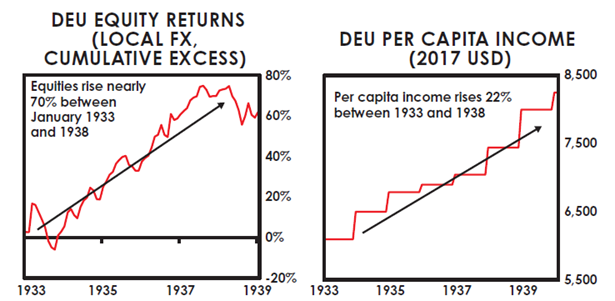
As for the economic effects of these policies, when Hitler came to power in 1933 the unemployment rate was 25 percent. By 1938 it was nil. Per capita income increased by 22 percent in the five years after Hitler took power, and real growth averaged over 8 percent per year between 1934 and 1938. As shown in the following charts, German equities rallied nearly 70 percent in a steady trend between 1933 and 1938, until the onset of the hot war.
至于这些政策的经济效果,1933年希特勒上台时失业率为25%,到1938年降为零。希特勒执政后的五年内,人均收入增长了22%,1934年至1938年间实际经济增长率年均超过8%。如以下图表所示,1933年至1938年间,德国股市稳步上涨了近70%,直到热战爆发。
In 1935, Hitler began to build the military, making military service compulsory for Aryans. Germany’s military spending increased much faster than any other country because the German economy needed more resources to fuel itself and it intended to use its military power to seize them.
1935年,希特勒开始扩充军备,强制雅利安人服兵役。德国的军事支出增速远超任何其他国家,因为德国经济需要更多资源来维持运转,而它打算动用军事力量来夺取这些资源。
Like Germany, Japan was also hit exceptionally hard by the depression and became more autocratic in response. Japan was especially vulnerable to the depression because, as an island nation without adequate natural resources, it relied on exports for income to import necessities. When its exports fell by around 50 percent between 1929 and 1931, Japan was economically devastated. In 1931, Japan went broke—i.e., it was forced to draw down its gold reserves, abandon the gold standard, and float its currency, which depreciated it so greatly that Japan ran out of buying power. These terrible conditions and large wealth gaps led to fighting between the left and the right. By 1932, there was a massive upsurge in right-wing nationalism and militarism, in the hope that order and economic stability could be forcibly restored. Japan set out to get the natural resources (e.g., oil, iron, coal, and rubber) and human resources (i.e., slave labor) it needed by seizing them from other countries, invading Manchuria in 1931 and spreading out through China and Asia. As with Germany, it could be argued that Japan’s path of military aggression to get needed resources was more cost-effective than relying on classic trading and economic practices. In 1934, there was severe famine in parts of Japan, causing even more political turbulence and reinforcing the right-wing, militaristic, nationalistic, and expansionistic movement.
与德国一样,日本也受到大萧条的严重冲击,并因此走向更加专制的道路。日本对大萧条尤其脆弱,因为作为一个缺乏充足自然资源的岛国,它依赖出口收入来进口必需品。1929年至1931年间,日本的出口下降了约50%,经济遭受毁灭性打击。1931年,日本陷入破产——即被迫消耗黄金储备、放弃金本位制、让货币自由浮动,导致货币大幅贬值,日本丧失了购买力。这些恶劣的条件和巨大的贫富差距导致了左翼与右翼之间的激烈冲突。到1932年,右翼民族主义和军国主义大规模兴起,期望通过强力手段恢复秩序和经济稳定。日本开始通过从其他国家夺取所需的自然资源(如石油、铁矿、煤炭和橡胶)和人力资源(即奴隶劳动力),于1931年入侵满洲(Manchuria),并向中国和亚洲其他地区扩张。与德国的情况类似,可以说日本通过军事侵略获取所需资源的路径,比依靠传统贸易和经济手段更具成本效益。1934年,日本部分地区发生严重饥荒,引发了更大的政治动荡,进一步强化了右翼、军国主义、民族主义和扩张主义运动。
In the years that followed, Japan’s top-down fascist command economy grew stronger, building a military-industrial complex to protect its existing bases in East Asia and northern China and support its excursions into other countries. As was also the case in Germany, while most Japanese companies remained privately held, their production was controlled by the government.
在随后的几年里,日本自上而下的法西斯统制经济日益强大,建立起军事工业综合体,以保护其在东亚和中国北方的现有据点,并支持其对其他国家的军事扩张。与德国的情况一样,虽然大多数日本企业仍为私人所有,但其生产活动受到政府的控制。
What is fascism? Consider the following three big choices that a country has to make when selecting its approach to governance:
什么是法西斯主义?请考虑一个国家在选择其治理方式时必须做出的以下三个重大选择:
- bottom-up (democratic) or top-down (autocratic) decision making, 2) capitalist or communist (with socialist in the middle) ownership of production, and 3) individualistic (which treats the well-being of the individual with paramount importance) or collectivist (which treats the well-being of the whole with paramount importance). Pick the one from each category that you believe preferred approach. Fascism is autocratic, capitalist, and collectivist.
1)自下而上(民主)还是自上而下(专制)的决策方式;2)资本主义还是共产主义(社会主义居于两者之间)的生产资料所有制;3)个人主义(将个人福祉视为至高无上)还是集体主义(将整体福祉视为至高无上)。从每个类别中选出你认为最优的方式。法西斯主义是专制的、资本主义的和集体主义的。
Fascists believe that top-down autocratic leadership, in which the government directs the production of privately held companies such that individual gratification is subordinated to national success, is the best way to make the country and its people wealthier and more powerful.
法西斯主义者认为,自上而下的专制领导——由政府指挥私营企业的生产,使个人满足服从于国家成功——是使国家及其人民变得更加富裕和强大的最佳途径。
The US and the Allies
美国与同盟国
In the US, debt problems became ruinous for American banks after 1929, which curtailed their lending around the world, hurting international borrowers. At the same time, the depression created weak demand, which led to a collapse of US imports and other countries’ sales to the US. As incomes weakened, demand fell and more credit problems occurred in a self-reinforcing downward economic spiral. The US responded by turning protectionist to safeguard jobs, raising tariffs via the passage of the Smoot-Hawley Tariff Act in 1930, which further depressed economic conditions in other countries.
在美国,1929年之后,债务问题对美国银行造成了毁灭性打击,银行因此削减了在全球范围内的贷款,伤害了国际借款人。与此同时,大萧条导致需求疲软,美国进口大幅下滑,其他国家对美出口也随之崩溃。随着收入减少,需求下降,更多信贷问题接踵而至,形成了一个自我强化的经济下行螺旋。美国的应对之策是转向保护主义以保住就业岗位,于1930年通过《斯穆特-霍利关税法》(Smoot-Hawley Tariff Act)提高关税,这进一步恶化了其他国家的经济状况。
* Raising tariffs to protect domestic businesses and jobs during bad economic times is common, but it leads to reduced efficiency because production does not occur where it can be done most efficiently. Ultimately, tariffs contribute to greater global economic weakness, as tariff wars cause the countries that impose them to lose exports. Tariffs do, however, benefit the entities that are protected by them, and they can create political support for the leaders who impose them.
* 在经济不景气时期提高关税以保护国内企业和就业是常见做法,但这会导致效率降低,因为生产并未在最具效率的地方进行。最终,关税会加剧全球经济疲软,因为关税战会导致征收关税的国家反而失去出口市场。然而,关税确实有利于受其保护的实体,并且能为实施关税的领导人创造政治支持。
The Soviet Union had yet to recover from its devastating 1917–22 revolution and civil war, a lost war to Germany, a costly war with Poland, and a famine in 1921, and it was wracked by political purges and economic hardships throughout the 1930s. China also suffered from civil war, poverty, and a famine in 1928–30. So, when things worsened in 1930 and tariffs began, bad conditions became desperate conditions in those countries.
苏联尚未从1917至1922年间毁灭性的革命和内战、对德战争的失败、与波兰代价高昂的战争以及1921年的大饥荒中恢复过来,并且在整个1930年代都饱受政治清洗和经济困苦的折磨。中国同样深陷内战、贫困以及1928至1930年的大饥荒之中。因此,当1930年局势进一步恶化、关税壁垒开始竖起时,这些国家的糟糕处境变成了绝望的困境。
To make matters worse, there were droughts in the US and in the Soviet Union in the 1930s. * Harmful acts of nature (e.g., droughts, floods, and plagues) often cause periods of great economic hardship that when combined with other adverse conditions lead to periods of great conflict. In combination with extreme government policies, millions died in the USSR. At the same time, internal political fighting and fears of Nazi Germany led to purges of hundreds of thousands of people who were accused of spying and shot without trials.
雪上加霜的是,1930年代美国和苏联都遭遇了严重旱灾。* 自然灾害(如旱灾、洪灾和瘟疫)往往会造成严重的经济困难时期,当与其他不利条件叠加时,就会引发剧烈冲突。在极端政府政策的共同作用下,苏联有数百万人丧生。与此同时,内部政治斗争和对纳粹德国的恐惧导致了大清洗,数十万人被指控为间谍,未经审判即遭枪决。
* Deflationary depressions are debt crises caused by there not being enough money in the hands of debtors to service their debts. They inevitably lead to the printing of money, debt restructurings, and government spending programs that increase the supply of, and reduce the value of, money and credit. The only question is how long it takes for government officials to make this move.
* **通缩性萧条是由于债务人手中没有足够的资金来偿还债务而引发的债务危机。**它们不可避免地会导致印钞、债务重组和政府支出计划,这些举措增加了货币和信贷的供给,同时降低了其价值。唯一的问题是政府官员需要多长时间才会采取这一步。
In the case of the US, it took three and a half years from the crash in October 1929 until President Franklin D. Roosevelt’s March 1933 actions. In Roosevelt’s first 100 days in office, he created several massive government spending programs that were paid for by big tax increases and big budget deficits financed by debt that the Federal Reserve monetized. He instituted jobs programs, unemployment insurance, Social Security supports, and labor- and union friendly programs. After his 1935 tax bill, then popularly called the “Soak the Rich Tax,” the top marginal income tax rate for individuals rose to 75 percent (versus as low as 25 percent in 1930). By 1941, the top personal tax rate was 81 percent, and the top corporate tax rate was 31 percent, having started at 12 percent in 1930. Roosevelt also imposed a number of other taxes. Despite all of these taxes and the pickup in the economy that helped raise tax revenue, budget deficits increased from around 1 percent of GDP to about 4 percent of GDP because the spending increases were so large. From 1933 until the end of 1936 the stock market returned over 200 percent, and the economy grew at a blistering average real rate of about 9 percent.
就美国而言,从1929年10月股市崩盘到富兰克林·D·罗斯福(Franklin D. Roosevelt)总统1933年3月采取行动,历经了三年半。在罗斯福执政的头100天里,他推出了多项大规模政府支出计划,资金来源于大幅增税和巨额预算赤字——这些赤字通过发债融资,再由美联储(Federal Reserve)将其货币化。他设立了就业计划、失业保险、社会保障支持以及有利于劳工和工会的政策。在1935年的税收法案——当时被民间戏称为"劫富税"(Soak the Rich Tax)——通过后,个人最高边际所得税率攀升至75%(而1930年最低仅为25%)。到1941年,个人最高税率达到81%,企业最高税率达到31%,而1930年时仅为12%。罗斯福还征收了许多其他税种。尽管有这些税收以及经济复苏带来的税收增长,预算赤字仍从GDP的约1%上升到约4%,因为支出增幅实在太大。从1933年到1936年底,股市回报率超过200%,经济以约**9%**的惊人平均实际增长率高速增长。
In 1936, the Federal Reserve tightened money and credit to fight inflation and slow an overheating economy, which caused the fragile US economy to fall back into recession and the other major economies to weaken with it, further raising tensions within and between countries.
1936年,美联储收紧了货币和信贷以应对通胀、为过热经济降温,这导致脆弱的美国经济重新陷入衰退,其他主要经济体也随之走弱,进一步加剧了各国内部及国家之间的紧张局势。
Meanwhile in Europe, the conflict in Spain between the populists of the left (the communists) and the populists of the right (the fascists) flared into the brutal Spanish Civil War. Right-wing Franco, with the support of Hitler, succeeded in purging left-wing opposition in Spain.
与此同时在欧洲,西班牙左翼民粹主义者(共产主义者)与右翼民粹主义者(法西斯主义者)之间的冲突升级为残酷的西班牙内战。右翼的佛朗哥(Franco)在希特勒的支持下,成功清除了西班牙的左翼反对势力。
* During periods of severe economic distress and large wealth gaps, there are typically revolutionarily large redistributions of wealth. When done peacefully these are achieved through large tax increases on the rich and big increases in the supply of money that devalue debtors’ claims, and when done violently they are achieved by forced asset confiscations. In the US and the UK, while there were redistributions of wealth and political power, capitalism and democracy were maintained. In Germany, Japan, Italy, and Spain they were not.
* **在严重经济困境和巨大贫富差距时期,通常会发生革命性的大规模财富再分配。**以和平方式实现时,这通过对富人大幅增税和大量增发货币——从而稀释债务人的债权价值——来达成;以暴力方式实现时,则通过强制没收资产来完成。在美国和英国,虽然财富和政治权力经历了再分配,但资本主义和民主制度得以维持。而在德国、日本、意大利和西班牙,则未能如此。
* Before there is a shooting war there is usually an economic war. As is also typical, before all-out wars are declared there is about a decade of economic, technological, geopolitical, and capital wars, during which the conflicting powers intimidate each other, testing the limits of each other’s power. While 1939 and 1941 are known as the official starts of the wars in Europe and the Pacific, the conflicts really began about 10 years before that. In addition to the economically motivated conflicts within countries and the political shifts that arose from them, all of these countries faced increased external economic conflicts as they fought for greater shares of a shrinking economic pie. Because power, and not law, rules international relations, Germany and Japan became more expansionist and increasingly began to test the UK, the US, and France in the competition over resources and influence over territories.
* **在爆发热战之前,通常会先有一场经济战。**同样典型的是,在全面战争宣告之前,大约会有十年的经济战、技术战、地缘政治战和资本战,在此期间对立大国互相恐吓,试探彼此的力量边界。虽然1939年和1941年被认为是欧洲和太平洋战争的正式起点,但冲突实际上在大约十年前就已经开始了。除了各国内部由经济动因引发的冲突以及由此产生的政治转向之外,所有这些国家还面临着日益加剧的外部经济冲突,因为它们都在争夺不断缩小的经济蛋糕中更大的份额。由于国际关系中起决定作用的是实力而非法律,德国和日本变得更加扩张主义,并开始越来越频繁地在资源争夺和领土影响力方面试探英国、美国和法国的底线。
Before going on to describe the hot war, I want to elaborate on the common tactics used when economic and capital tools are weaponized.
在继续描述热战之前,我想详细阐述经济和资本工具被武器化时常用的策略。
They have been and still are:
这些策略过去存在,现在依然如此:
Asset freezes/seizures: Preventing an enemy/rival from using or selling foreign assets they rely on. These measures can range from asset freezes for targeted groups in a country (e.g., the current US sanctions of the Iranian Revolutionary Guard or the initial US asset freeze against Japan in World War II) to more severe measures like unilateral debt repudiation or outright seizures of a country’s assets (e.g., some top US policy makers have been talking about not paying our debts to China).
资产冻结/没收:阻止敌人或对手使用或出售其所依赖的海外资产。这些措施从针对一国特定群体的资产冻结(例如,美国目前对伊朗革命卫队的制裁,或二战时期美国最初对日本的资产冻结),到更严厉的措施如单方面拒绝偿还债务或直接没收一国资产(例如,一些美国高层决策者一直在谈论不偿还对中国的债务)。
Blocking capital markets access: Preventing a country from accessing their own or another country’s capital markets (e.g., in 1887 Germany banned the purchase of Russian securities and debt to impede Russia’s military buildup; the US is now threatening to do this to China).
封锁资本市场准入:阻止一个国家进入本国或另一国的资本市场(例如,1887年德国禁止购买俄罗斯证券和债券,以阻碍俄罗斯的军事建设;美国目前正威胁对中国采取同样的做法)。
Embargoes/blockades: Blocking trade in goods and/or services in one’s own country and in some cases with neutral third parties for the purpose of weakening the targeted country or preventing it from getting essential items (e.g., the US’s oil embargo on Japan and cutting off its ships’ access to the Panama Canal in World War II) or blocking exports from the targeted country to other countries, thus cutting off their income (e.g., France’s blockade of the UK in the Napoleonic Wars).
禁运/封锁:在本国范围内——某些情况下还涉及中立第三方——封锁商品和/或服务贸易,目的是削弱目标国家或阻止其获得关键物资(例如,二战中美国对日本的石油禁运以及切断其船只通过巴拿马运河的通道),或者封锁目标国家向其他国家的出口,从而切断其收入来源(例如,拿破仑战争中法国对英国的封锁)。
If you’re interested in seeing how these tactics have been applied from 1600 until now, they are available at economicprinciples.org.
如果您有兴趣了解这些策略从1600年至今的应用情况,可以在 economicprinciples.org 上查阅。
THE HOT WAR BEGINS
热战开始
In November 1937, Hitler secretly met with his top officials to announce his plans for German expansion to gain resources and bring together the Aryan race. Then he put them into action, first annexing Austria and then seizing a part of what was then Czechoslovakia that contained oil resources. Europe and the US watched warily, not wanting to get drawn into another war so soon after the devastation of World War I.
1937年11月,希特勒秘密会见了他的高级官员,宣布了德国扩张以获取资源和统一雅利安(Aryan)种族的计划。随后他将计划付诸行动,先是吞并了奥地利,接着夺取了当时捷克斯洛伐克境内含有石油资源的部分地区。欧洲和美国保持警惕地观望着,不愿在第一次世界大战的浩劫之后这么快又被卷入另一场战争。
As with all wars, the unknowns were far greater than the knowns because a) rival powers go into wars only when their powers are roughly comparable (otherwise it would be stupidly suicidal for the obviously weaker power) and b) there are way too many possible actions and reactions to anticipate. The only thing that is known at the outset of a hot war is that it will probably be extremely painful and possibly ruinous. As a result, smart leaders typically go into them only if the other side has pushed them into a position of either fighting or losing by backing down. For the Allies, that moment came on September 1, 1939, when Germany invaded Poland.
与所有战争一样,未知远大于已知,因为:a)敌对势力只有在实力大致相当时才会开战(否则对于明显弱势的一方来说,开战无异于愚蠢的自杀行为);b)可能的行动与反应太多,根本无法预判。在热战伊始,唯一确知的是它可能极其痛苦,甚至可能是毁灭性的。因此,明智的领导人通常只有在对方将他们逼入要么战斗、要么退让认输的境地时才会开战。对同盟国来说,那个时刻是1939年9月1日——德国入侵波兰。
Germany looked unstoppable; in short order it captured Denmark, Norway, the Netherlands, Belgium, Luxembourg, and France, and strengthened its alliances with Japan and Italy, which had common enemies and were ideologically aligned. By seizing territory rapidly (e.g., oil-rich Romania), Hitler’s army was able to conserve its existing oil resources and gain new ones quickly. The thirst for, and acquisition of, natural resources remained a major driver of the Nazi war machine as it pushed its campaigns into Russia and the Middle East. War with the Soviets was inevitable; the only question was when. Although Germany and the USSR had signed a non-aggression pact, Germany invaded Russia in June 1941, which put Germany in an extremely costly war on two fronts.
德国看起来势不可挡;它迅速攻占了丹麦、挪威、荷兰、比利时、卢森堡和法国,并加强了与日本和意大利的同盟关系——这些国家有着共同的敌人且在意识形态上一致。通过快速夺取领土(例如石油资源丰富的罗马尼亚),希特勒的军队得以节省现有石油资源,同时迅速获取新的资源。对自然资源的渴求与掠夺始终是纳粹战争机器的主要驱动力,推动其将战役扩展到俄罗斯和中东。与苏联的战争不可避免,唯一的问题是何时开战。尽管德国与苏联签署了互不侵犯条约,德国仍于1941年6月入侵苏联,这使德国陷入了代价极其高昂的两线作战。
In the Pacific in 1937, Japan expanded its occupation of China, brutally taking control of Shanghai and Nanking, killing an estimated 200,000 Chinese civilians and disarmed combatants in the capture of Nanking alone. While the US remained isolationist, it did provide Chiang Kai-shek’s government with fighter planes and pilots to counter the Japanese, putting a toe in the war. Conflicts between the US and Japan began to flare. A Japanese soldier struck the US consul, John Moore Allison, in the face in Nanking and Japanese fighter planes sank a US gunship.
在太平洋地区,1937年日本扩大了对中国的占领,残暴地控制了上海和南京,仅在攻占南京一役中就屠杀了约20万中国平民和已缴械的战斗人员。虽然美国仍然奉行孤立主义,但确实向蒋介石政府提供了战斗机和飞行员以对抗日本,算是初步涉足了战争。美日之间的冲突开始激化。一名日本士兵在南京打了美国领事约翰·摩尔·阿利森(John Moore Allison)的脸,日本战斗机也击沉了一艘美国炮舰。
In November 1940, Roosevelt won re-election after campaigning on the promise to keep the US out of the war, even though the US was already taking economic actions to protect its interests, especially in the Pacific, using economic supports to help countries it sympathized with and economic sanctions against those it did not. Earlier in 1940, Secretary of War Henry Stimson had initiated aggressive economic sanctions against Japan, culminating in the Export Control Act of 1940. In mid-1940, the US moved the US Pacific Fleet to Hawaii. In October, the US ramped up the embargo, restricting “all iron and steel to destinations other than Britain and nations of the Western Hemisphere.” The plan was to cut Japan off from resources in order to force them to retreat from most of the areas they had taken over.
1940年11月,罗斯福以承诺让美国远离战争的竞选纲领赢得连任,尽管美国实际上已经在采取经济行动保护自身利益,尤其是在太平洋地区——通过经济支持帮助它同情的国家,通过经济制裁打击它不认同的国家。1940年早些时候,战争部长亨利·史汀生(Henry Stimson)已发起对日本的强硬经济制裁,最终促成了1940年的《出口管制法》(Export Control Act of 1940)。1940年中期,美国将太平洋舰队移驻夏威夷。10月,美国加大禁运力度,限制"除英国和西半球国家以外的所有目的地的钢铁出口"。其计划是切断日本的资源供应,迫使其从已占领的大部分地区撤退。
In March 1941, Congress passed the Lend-Lease Act, which allowed the US to lend or lease war supplies to the nations it deemed to be acting in ways that were “vital to the defense of the United States,” which included Great Britain, the Soviet Union, and China. Helping the Allies was good for the US both geopolitically and economically because it made a lot of money selling weapons, food, and other items to these soon-to-be-allied countries who were struggling to maintain production while waging war. But its motivations weren’t entirely mercenary. Great Britain was running out of money (i.e., gold), so the US allowed them to postpone payment until after the war (in some cases waiving payment entirely). Although not an outright declaration of war, Lend-Lease effectively ended the United States’ neutrality.
1941年3月,国会通过了《租借法案》(Lend-Lease Act),允许美国向其认定的行为"对美国防务至关重要"的国家借出或租赁战争物资,其中包括英国、苏联和中国。帮助同盟国对美国在地缘政治和经济上都有好处,因为通过向这些即将结盟的国家出售武器、食品和其他物资获取了大量收入——这些国家在进行战争的同时难以维持生产。但美国的动机并非完全出于利益。英国的资金(即黄金)即将耗尽,因此美国允许他们将付款推迟到战后(在某些情况下甚至完全免除了付款)。虽然《租借法案》并非正式宣战,但它实际上终结了美国的中立立场。
* When countries are weak, opposing countries take advantage of their weaknesses to obtain gains. France, the Netherlands, and Great Britain all had colonies in Asia. Overstretched by the fighting in Europe, they were unable to defend them against the Japanese. Starting in September 1940, Japan invaded several colonies in Southeast Asia, beginning with French Indochina, adding what it called the Southern Resource Zone to its Greater East Asia Co-Prosperity Sphere. In 1941, Japan seized oil reserves in the Dutch East Indies.
* **当国家虚弱时,敌对国家会利用其弱点来谋取利益。**法国、荷兰和英国都在亚洲拥有殖民地。由于在欧洲战场上力量过度分散,它们无力抵御日本的进攻。从1940年9月开始,日本入侵了东南亚的多个殖民地,首先是法属印度支那,将其所谓的"南方资源区"纳入"大东亚共荣圈"(Greater East Asia Co-Prosperity Sphere)。1941年,日本夺取了荷属东印度群岛(Dutch East Indies)的石油储备。
This Japanese territorial expansion was a threat to the US’s own Pacific ambitions. In July and August 1941, Roosevelt responded by freezing all Japanese assets in the United States, closing the Panama Canal to Japanese ships, and embargoing oil and gas exports to Japan. This cut off three-fourths of Japan’s trade and 80 percent of its oil. Japan calculated that it would run out of oil in two years. This put Japan in the position of having to choose between backing down or attacking the US.
日本的领土扩张对美国自身的太平洋野心构成了威胁。1941年7月和8月,罗斯福的回应是冻结日本在美国的所有资产、关闭巴拿马运河禁止日本船只通行、并对日本实施石油和天然气出口禁运。这切断了日本四分之三的贸易和百分之八十的石油供应。日本估算其石油储备将在两年内耗尽。这将日本推到了必须在退让或进攻美国之间做出选择的境地。
On December 7 and 8, 1941, Japan launched coordinated attacks on US military forces at Pearl Harbor and in the Philippines. This marked the beginning of the declared war in the Pacific, which brought the US into the war in Europe too. While Japan didn’t have a widely recognized plan to win the war, the most optimistic Japanese leaders believed that the US would lose because it was fighting a war on two fronts and because its individualistic/capitalist political system was inferior to Japan’s and Germany’s authoritarian/fascist systems with their command military-industrial complexes. They also believed that they had a greater willingness to endure and die for their country, which is a big driver of which side wins. * In war one’s ability to withstand pain is even more important than one’s ability to inflict pain.
1941年12月7日和8日,日本对美国在珍珠港(Pearl Harbor)和菲律宾的军事力量发动了协调攻击。这标志着太平洋宣战的开始,也将美国拖入了欧洲战场。虽然日本没有一个广为人知的赢得战争的计划,但最乐观的日本领导人认为美国会败北,因为它在两线作战,而且其个人主义/资本主义的政治体制不如日本和德国的威权/法西斯体制及其指令型军事工业综合体。他们还相信自己比对手更愿意为国家忍耐和牺牲,而这是决定哪方获胜的重要因素。* 在战争中,承受痛苦的能力甚至比施加痛苦的能力更为重要。
WARTIME ECONOMIC POLICIES
战时经济政策
Just as it is worth noting what classic economic war tactics are, it is also worth noting what classic wartime economic policies are within countries. These include government controls on just about everything as the country shifts its resources from profit making to war making—e.g., the government determines a) what items are allowed to be produced, b) what items can be bought and sold in what amounts (rationing), c) what items can be imported and exported, d) prices, wages, and profits, e) access to one’s own financial assets, and f) the ability to move one’s own money out of the country. Because wars are expensive, classically the government g) issues lots of debt that is monetized, h) relies on non-credit money such as gold for international transactions because its credit is not accepted, i) governs more autocratically, j) imposes various types of economic sanctions on enemies, including cutting off their access to capital, and k) experiences enemies imposing these sanctions on them.
正如值得了解经典的经济战术一样,同样值得了解各国国内的经典战时经济政策。这些政策包括政府对几乎一切事物的管控,因为国家将资源从盈利转向备战——例如,政府决定:a)允许生产哪些物品,b)哪些物品可以买卖及其配额(配给制),c)哪些物品可以进出口,d)物价、工资和利润水平,e)个人金融资产的使用权限,f)将资金转移出境的能力。由于战争耗资巨大,传统上政府还会:g)大量发行债务并将其货币化,h)依赖黄金等非信用货币进行国际交易,因为其信用不被接受,i)以更加专制的方式进行治理,j)对敌国施加各种经济制裁,包括切断其资本渠道,k)同时也遭受敌国对自己施加的同类制裁。
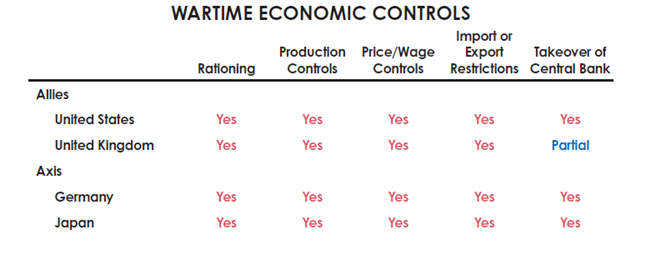
When the US entered the European and Pacific wars after the attack on Pearl Harbor, classic wartime economic policies were put in place in most countries by leaders whose more autocratic approaches were broadly supported by their populations. The following table shows those economic controls in each of the major countries.
珍珠港遇袭后,美国加入了欧洲和太平洋战争,大多数国家都实施了经典的战时经济政策,其领导人更加专制的治理方式得到了本国民众的广泛支持。下表展示了各主要国家的经济管控措施。
The market movements during the hot war years were heavily affected by both government controls and how countries did in battles as the odds of winning and losing changed. The next table shows the controls over markets and capital flows that were put in place by the major countries during the war years.
热战年间的市场走势深受两方面因素的影响:一是政府管控,二是各国在战役中的表现——随着胜负概率的变化而波动。下表展示了主要国家在战争年代对市场和资本流动实施的管控措施。
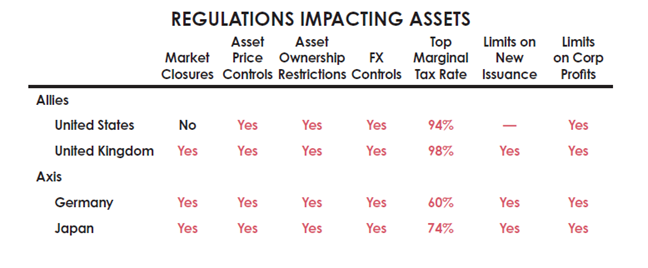
Stock market closures were common in a number of countries, leaving investors in stocks stuck without access to their capital. I should also note that money and credit were not commonly accepted between non-allied countries during the war because of a justifiable wariness about whether the currency would have any value. As noted earlier, gold—or, in some cases, silver or barter—is the coin of the realm during wars. At such times, prices and capital flows are typically controlled, so it is difficult to say what the real prices of many things are.
股票市场关闭在许多国家都很常见,导致股票投资者被困住,无法动用其资本。还需指出的是,战争期间非同盟国之间通常不接受彼此的货币和信用,这是由于对货币是否还有价值的合理警惕。如前所述,黄金——在某些情况下是白银或以物易物——才是战时的硬通货。在这种时候,物价和资本流动通常受到管控,因此很难判断许多事物的真实价格。
Because losing wars typically leads to a total wipeout of wealth and power, movements of those stock markets that remained open in the war years were largely driven by how countries did in key battles as these results shifted the probability of victory or defeat for each side. For example, German equities outperformed at the beginning of World War II as Germany captured territory and established military dominance, while they underperformed after Allied powers like the US and the UK turned the tide of the war. After the 1942 Battle of Midway, Allied equities rallied almost continuously until the end of the war, while Axis equities were flat or down. As shown, both the German and Japanese stock markets were closed at the end of the war, didn’t reopen for around five years, and were virtually wiped out when they did, while US stocks were extremely strong.
由于战败通常会导致财富和权力的彻底覆灭,战争年代仍在运行的股票市场的走势主要取决于各国在关键战役中的表现,因为这些结果改变了各方胜败的概率。例如,二战初期德国攻占领土并建立军事优势时,德国股票表现优异;而当美国和英国等同盟国扭转战局后,德国股票表现则急剧下滑。1942年中途岛海战(Battle of Midway)之后,同盟国股市几乎持续上涨直至战争结束,而轴心国股市则持平或下跌。如图所示,德国和日本的股票市场在战争结束时均被关闭,约五年后才重新开放,重新开放时几乎被彻底清零;与此同时,美国股市则极为强劲。
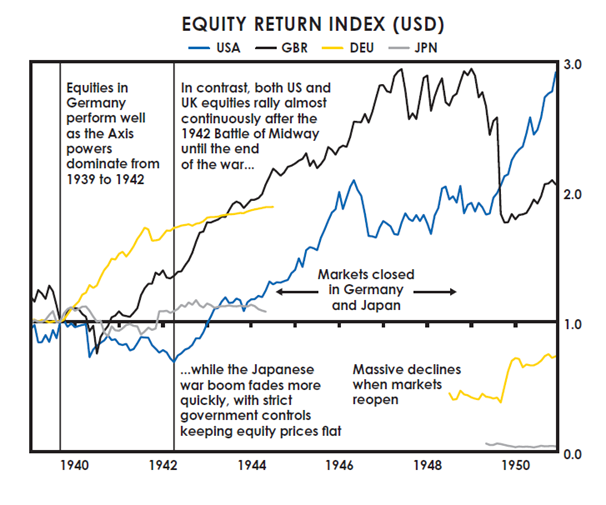
Protecting one’s wealth in times of war is difficult, as normal economic activities are curtailed, traditionally safe investments are not safe, capital mobility is limited, and high taxes are imposed when people and countries are fighting for their survival. Protecting the wealth of those who have it is not a priority relative to the need to redistribute wealth to get it to where it is needed most. As for investing, sell out of all debt and buy gold because wars are financed by borrowing and printing money, which devalues debt and money, and because there is a justifiable reluctance to accept credit.
在战争时期保护财富是困难的,因为正常的经济活动被压缩,传统上安全的投资不再安全,资本流动性受限,在人们和国家为生存而战时还会征收高额税收。相对于将财富重新分配到最需要之处的迫切需求,保护富人的财富并非优先事项。至于投资建议:卖掉所有债券,买入黄金——因为战争靠借债和印钞来融资,这会使债务和货币贬值;同时人们有充分理由拒绝接受信用。
CONCLUSION
结论
Every world power has its time in the sun, thanks to the uniqueness of their circumstances and the nature of their character and culture (e.g., they have the essential elements of a strong work ethic, smarts, discipline, education, etc.), but they all eventually decline. Some do so more gracefully than others, with less trauma, but they nevertheless decline. Traumatic declines can lead to some of the worst periods in history, when big fights over wealth and power prove extremely costly both economically and in human lives.
每个世界强国都有其辉煌时期,这得益于其独特的历史境遇和国民性格与文化的特质(例如,它们具备强烈的职业道德、聪明才智、纪律性、良好教育等关键要素),但它们最终都会走向衰落。有些国家的衰落比其他国家更为从容,创伤更少,但终究难逃衰落的命运。剧烈的衰落可能导致历史上最黑暗的时期——围绕财富和权力的激烈争斗在经济上和人类生命方面都付出了极其惨重的代价。
Still, the cycle needn’t transpire this way if countries in their rich and powerful stages stay productive, earn more than they spend, make the system work well for most of their populations, and figure out ways of creating and sustaining win-win relationships with their most significant rivals. A number of empires and dynasties have sustained themselves for hundreds of years, and the United States, at 245 years old, has proven itself to be one of the longest-lasting.
然而,如果处于富强阶段的国家能够保持生产力、量入为出、让制度惠及大多数国民,并找到与最重要的竞争对手建立和维持双赢关系的方式,这一循环并非必然如此演变。许多帝国和王朝延续了数百年之久,而美国建国245年至今,已证明自己是最持久的国家之一。
作者核心观点总结
From: Claude Opus 4.6
一、世界秩序的终结
- 2026年慕尼黑安全会议上,德国总理默茨、法国总统马克龙、美国国务卿卢比奥等主要领导人一致宣告:1945年以来的世界秩序已正式终结,我们进入了大国政治的新时代。这不是某个评论员的观点,而是全球主要大国领导人的共识
- 按照 Dalio 的分析框架,当前处于**“大周期”(Big Cycle)第六阶段**——一个没有规则、强权即公理、大国激烈碰撞的混乱时期。历史上每次进入这个阶段,都伴随着巨大的动荡和重新洗牌
二、国际关系的本质
- 国际关系的本质是丛林法则而非国际法——权力决定一切。联合国、国际联盟等国际组织因实力不及最强大的国家,从未能真正有效维持秩序。当单个国家的力量超过国际组织时,决定事态走向的永远是强国而非机构
- 国家间存在五种主要争斗形式:贸易/经济战、技术战、资本战、地缘政治战、军事战。这五种战争并非孤立存在,前四种通常是军事战争的前奏,一旦热战爆发,其余四种都会被最大限度地武器化
- 欧洲自1500年以来经历了三个约150年的冲突大周期(文艺复兴→三十年战争、启蒙运动→拿破仑战争、工业革命→两次世界大战),每次长期和平繁荣都恰恰为下一轮惨烈战争埋下了种子
三、战争的逻辑
- 关于战争最确定的两件事:1)不会按计划进行;2)远比想象中糟糕。正因如此,Dalio 反复强调应尽一切努力避免武装冲突
- 财富等于权力——一个国家必须同时负担得起"枪炮"(军事力量)和"黄油"(国民生活水平),否则将面临内外威胁。美国在冷战中正是靠财力耗垮了苏联,而非靠一场热战
- 全面战争通常发生在事关国家存亡、且无法通过和平手段解决的问题上。战争的结果会清楚地表明谁来制定规则,而这种明确性成为新国际秩序的基础
- 军事战争的最大风险出现在双方军力大致相当且存在不可调和的存亡分歧时。Dalio 明确指出,当前最具爆发性的冲突是美中围绕台湾的对峙
四、滑入战争的四大陷阱
- 囚徒困境:敌对大国需要找到方法向对方保证自己不会先发制人,但这种互信极难建立
- 以牙还牙的升级:每一步升级都要求对方要么跟进升级、要么接受损失,这就像一场胆小鬼博弈——逼得太紧就会迎头相撞
- 退让的高昂代价:对衰落中的大国而言,退让意味着示弱,导致支持减少,因此宁可冒战争风险也不愿主动让步
- 快速决策中的误判:当必须快速做出决定时,误解和误判往往导致灾难性的后果
- 不诚实的和煽动情绪的领导人言论会大幅增加"愚蠢战争"的风险,尤其是在民主国家中民意至关重要的背景下,更糟糕的是当领导人控制了媒体
五、双赢与权力运用
- 双赢远优于双输:精湛的合作远比征服对方更有价值。谈判的关键是站在对手角度思考,明确各自红线(不可妥协的底线),并懂得如何进行利益交换
- 胜利的定义:得到最重要的东西而不失去最重要的东西。以生命和金钱的代价远超收益的战争是愚蠢的,但这种愚蠢的战争仍然不断发生
- 核心原则:拥有权力、尊重权力、明智使用权力。软实力(慷慨与信任)往往比硬实力(强迫与威胁)更有效。权力最好像一把隐藏的刀,必要时才亮出来
- 权力使用的时机选择至关重要:权力处于上升期应推迟行动,处于下降期应尽早行动——在自身最强盛时谈判或行动最为有利
六、1930年代的历史镜鉴
- 1929年大萧条催生了全球性的民粹主义和专制转向:德日意西走向法西斯,苏中走向共产主义,美英虽也民粹化但因民主传统深厚而得以维持制度。一个国家在极端经济困境下走向何方,很大程度上取决于其既有的制度传统
- 法西斯主义的本质:专制 + 资本主义 + 集体主义——政府自上而下指挥私营企业的生产,个人满足服从于国家成功。这与共产主义的区别在于保留了生产资料私有制
- 德国案例:希特勒通过强制银行购买国债、央行货币化债务、大规模基础设施建设(大众汽车、高速公路)等手段实现经济奇迹——失业率从25%降至零,年均增长超8%,股市上涨近70%。这证明以本币借债投资于提高生产率的项目可以极其有效,但德国最终将这种能力转向军事扩张,走向毁灭
- 日本案例:作为资源匮乏的岛国,出口下降**50%**后经济崩溃,被迫放弃金本位、货币大幅贬值。在绝望中走上以军事掠夺资源(石油、铁矿、煤炭、橡胶)的道路,建立了"大东亚共荣圈"
- 经济不景气时提高关税是常见做法(如1930年《斯穆特-霍利关税法》),但会降低全球生产效率、引发关税战,最终导致征收关税的国家反而失去出口市场,各方皆输
- 自然灾害(旱灾、洪灾、瘟疫)与其他不利条件叠加时,往往引发剧烈冲突。1930年代美苏同时遭遇严重旱灾,雪上加霜
七、从经济战到热战
- 热战之前通常有约十年的经济战。1939年和1941年被视为战争正式起点,但冲突实际上在十年前就已经开始——以经济战、技术战、地缘政治战和资本战的形式逐步升级
- 经济武器化的三大经典策略:资产冻结/没收(阻止敌方使用海外资产)、封锁资本市场准入(切断融资渠道)、禁运/封锁(断绝关键物资供应)
- 美国对日本的经济绞杀:冻结日本在美全部资产、关闭巴拿马运河、石油禁运——切断了日本四分之三的贸易和**80%**的石油供应。日本估算石油储备仅够两年,被逼入要么退让要么偷袭珍珠港的绝境
- 美国自身的经济转型同样剧烈:罗斯福将个人最高税率从25%提升至81%,企业税率从12%提至31%,同时推出大规模政府支出计划,实现了**200%的股市回报和年均约9%**的经济增长
八、战时经济与财富保护
- 战时经济的核心特征:政府管控生产、消费(配给制)、价格、工资、进出口、资本流动;大量发债并货币化;更加专制的治理方式。这些措施在所有参战国中都有不同程度的实施
- 战时各国普遍不接受非盟国的货币和信用,黄金成为唯一被广泛接受的硬通货。物价和资本流动受到管控,很难判断任何东西的真实价格
- 股市走势由战场胜负驱动:1942年中途岛海战后,同盟国股市持续上涨直至战争结束;轴心国股市则持平或下跌。战败国的财富和权力会被彻底清零——德日股市战后关闭约五年,重开时几乎归零,而美国股市极为强劲
- 战时保护财富极其困难:正常经济活动被压缩,传统安全投资不再安全,资本流动受限,高额税收被征收。相对于将财富重新分配到最需要之处,保护富人财富并非优先事项
- Dalio 的战时投资建议:卖掉所有债券,买入黄金——因为战争靠借债和印钞融资,这会使债务和货币贬值;同时人们有充分理由拒绝接受信用
- 当信用货币因战争融资而不断贬值、资产因制裁而随时被冻结时,不依赖任何主权信用且能跨越国境的硬通货如黄金和 Bitcoin 将成为最后的避风港
九、历史启示与当下
- 每个世界强国都有其辉煌时期,但最终都会走向衰落。真正成功的国家能够维持200至300年的繁荣,但没有任何国家能永远做到
- 衰落并非必然以灾难性方式发生——关键在于保持生产力、量入为出、让制度惠及多数国民、与最重要的对手建立和维持双赢关系
- 1930年代与今天有惊人的相似性:全球经济压力上升、民粹主义和民族主义抬头、关税战升级、大国竞争加剧、国际秩序失效。美中经济战有可能沿着当年美日对抗的轨迹演变为军事冲突
- Dalio 并非在预言战争必然发生,而是在警告:如果不从历史中吸取教训、不积极寻求双赢解决方案,历史的悲剧完全有可能重演
最后修改于 2026-03-24

本作品采用知识共享署名-非商业性使用-相同方式共享 4.0 国际许可协议进行许可。